
3 The Language of the Land: Why Secwepemctsin Belongs in the Classroom
By Alexis Gottfriedson, Tk̓emlúpsemc
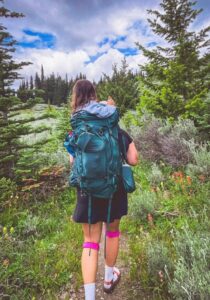
Weytkp xwexwéytep, Alexis Gottfriedson ren skwekwst te Tk̓emlúps re st̓7é7kwen. Ren qellmímen Sharon ell Ted Gottfriedson re skweskwést.s. Ren kí7ce te Tsq̓escén̓ re st̓7ékwes, ell ren qé7tse te Tk̓emlúps re st̓7ékwes. Ren kyé7e Evelyn ell ren xpé7e Ted Gottfriedson Sr. re skweskwést.s te Tk̓emlúps re stet̓7ékwes. Ren kyé7e Mabel Grant re skwest.s te Tsq̓escén̓ re st’7ékwes, ell len xpé7e le skwest.s John Grant.
Hello everyone, my name is Alexis Gottfriedson, and I am from Tk̓emlúps. My parents’ names are Sharon and Ted Gottfriedson. My mom is from Tsq̓escén̓, and my dad is from Tk̓emlúps. My dad’s parents are Evelyn and Ted Gottfriedson Sr., both from Tk̓emlúps. My mom’s parents are Mabel and John Grant, my grandma is from Tsq̓escén̓, and my late grandfather John has passed.
I share my story here because I believe it holds something important for educators: when the language of the land is absent from our classrooms, students pay a price that goes far deeper than curriculum. I know, because I lived it.
I grew up on my reserve in Tk̓emlúps. Though I was within Secwepemcúl̓ecw, I wasn’t deeply connected to my language and culture. Through elementary and high school, I had Secwepemctsín classes and was told our language was endangered, but that warning never truly resonated with me at the time. Looking back, I understand why.
Kamloops isn’t a small town, but it carries many small-town tendencies, and racism is significant there. When Indigenous peoples in Canada were included in the curriculum at all, the focus was almost entirely on negative history, on what was done to us, rather than who we are. I wasn’t able to recognize the impact of that until much later, when I began my language journey. That’s when I started to see how deeply it had shaped my sense of identity, and how much of my own internalized racism I had been carrying.
The system and my surroundings taught me that I needed to be seen as a “good Indian.” Learning my language and culture was not part of that ideal. And so I continued to navigate my life by what I had internalized as the “right way”: work toward a respected degree, enter the professional world, and prove myself within the colonized system as a “civilized person.”
After graduating with a science degree from the University of British Columbia, I felt I was on the right track, doing what society expected of me. I followed my passion, which had always been with me: I wanted to protect the land for future generations. This teaching, I now understand, had been carried through generations of Secwépemc knowledge. Even before I knew the word, the concept of Tellqelmúcw, future generations, was already woven into how I moved through the world.
I began working as a junior forester and field biologist, which sparked my passion for ornithology, the study of birds. But I quickly realized that saving the world wasn’t as simple as I had hoped. Environmental and wildlife surveys showed me that our recommendations were only things industry needed to consider before making decisions, as long as those decisions stayed within policy. That realization weighed on me. I started looking for work that felt more meaningful.
That search led me to a position as an ethno-biologist, where the primary goal was to learn my mother tongue and connect that knowledge to the land. I completed a Certificate and Diploma in Indigenous Language Proficiency in Secwepemctsín. Our cohort completed over 2,000 hours of immersion with fluent speakers, an experience that changed everything.
This program created a space where we were blessed to build deep, lasting relationships with many of the remaining fluent speakers within the Secwépemc Nation. I wasn’t only beginning my language-learning journey. I was also beginning to heal the part of myself that had internalized deep-rooted shame about my language and my culture.
Working with the fluent Elders in my Nation affected me in ways I will never be able to fully express or thank them for. Learning Secwepemctsín opened a safe space within my own cultural identity. It allowed me to see the beautiful way our ancestors understood the world, and to develop a deeper appreciation for the natural world around us. It allowed me to truly understand, not just as a concept, but as a lived experience, K̓wseltktenéws-kt: we are all related. Not only in how we, as humans, must recognize and be open to understanding one another, but in our connection to the land and in the respect we owe to all living things, as we owe to each other.
Learning Secwepemctsín gave me something I had never found in formal education: a sense of spiritual grounding rooted in my own experience, not a concept read from a page. It taught me how to truly walk in both worlds.
Coming back to the internalized racism I had been carrying, language was the key. Seeing the resilience of our fluent speakers, their strength and dedication to continuing to share and revitalize Secwepemctsín, allowed me to see my own identity differently. Through the powerful women and men in my family, I began to truly recognize the intergenerational trauma they endured, and the strength it took to create a better environment for my siblings, nieces, and nephews. I can now continue breaking that cycle, not by blaming them for the skills that were deliberately taken away, but by understanding the system that was designed to make us feel shame in our own homes and pull us away from belief systems built on love, equality, and peace.
For educators working in British Columbia, wherever you teach, I want to offer this: incorporating the language of the land is what creates genuine safety and belonging in a learning environment. This isn’t about a single cultural awareness day or a land acknowledgement. It’s about making the languages and worldviews of the peoples whose territory you teach on present in the everyday experience of learners.
For those teaching within Secwepemcúl̓ecw: Secwepemctsín belongs in your classroom. Not because it is required, but because its presence, even in small ways, says to every student who carries that identity: you belong here, and your way of knowing is valuable.
My story is one story. But I know I am not alone in having navigated an education system that taught me to be ashamed of who I am. Educators have the power to change that, one classroom, one relationship, one word at a time.
K̓wseltktenéws-kt. We are all related.